Blog
The 2020 SolarWinds attack exposed a hard truth: sophisticated adversaries could live inside federal networks for months, and most agencies lacked the logging, processes, and enterprise wide visibility to find them. OMB responded with M-21-31, which established government wide requirements for logging, log management, and data retention.
The reality of implementation was complicated. Agencies were absorbing rapidly evolving EDR, NDR, SIEM, and SOAR technologies while managing the demands of the pandemic, so much of the effort went toward deploying tools and meeting retention requirements rather than building true operational maturity. And the focus stayed almost entirely on traditional IT, leaving OT systems like building automation, utilities, and transportation outside enterprise monitoring strategies.
Five years later, the threat landscape has outgrown that model. Critical infrastructure is now a primary target for nation state adversaries, AI is introducing new systems and data sources into agency environments, and the lines between IT, IoT, OT, and AI platforms are blurring fast. That is why the recent release of OMB Memorandum M-26-14, Ensuring Effective and Efficient Agency Logging and Network Visibility to Defend Against Evolving Cyber Threats matters. It shifts the conversation from compliance driven log retention to comprehensive event monitoring and defense across the entire enterprise, because organizations cannot protect, investigate, or respond to what they cannot see.
With M-26-14, the federal government is acknowledging a simple reality: collecting data is no longer enough. Agencies need Continuous Event Monitoring (CEM) and Threat Hunting, Investigation, Response and Forensics (THIRF). In practical terms, that means knowing every system across the environment, understanding what percentage of IT, IoT, and OT devices are actually being logged, and running proactive Security Operations Centers (SOCs) that use AI/ML log analysis to sharpen cyber defense.
The stakes continue rising as agencies adopt AI and advanced analytics platforms, each bringing new applications, data sources, integrations, and attack vectors into IT environments that must be monitored and secured. M-26-14 establishes a framework for the foundational visibility agencies need to secure both today’s environments and tomorrow’s AI enabled operations.
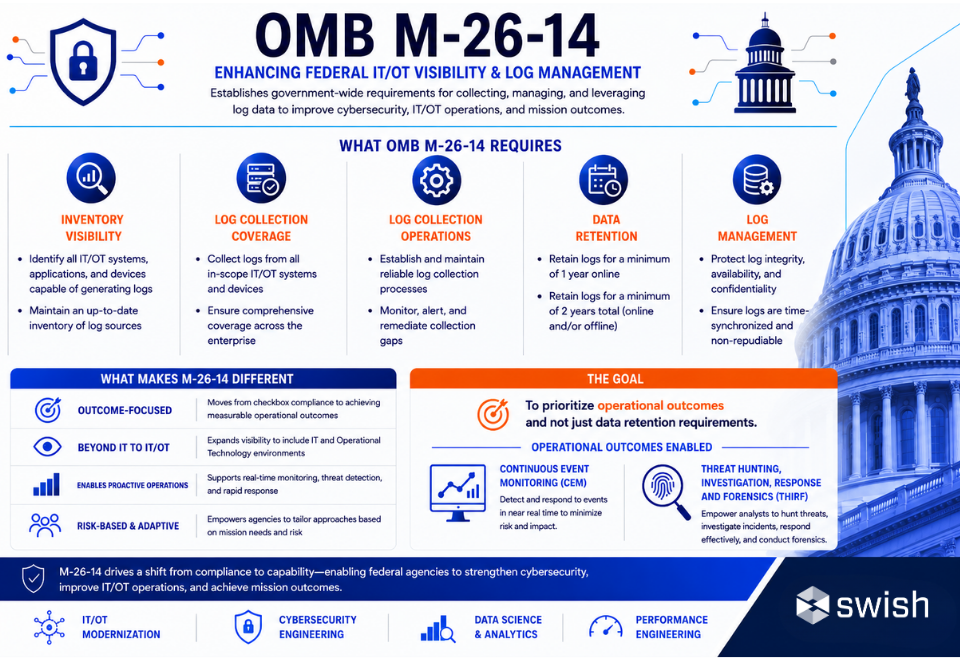
The memorandum is built on five capability areas that determine an agency’s Logging Maturity Model, with levels ranging from Ineffective (Level 0) to Optimal (Level 4).
M-26-14’s capabilities when deployed across federal IT environments will enable two critical operational outcomes : CEM, which gives agencies real time visibility into suspicious activity and emerging threats, and THIRF, which equips them to proactively hunt threats, investigate incidents, and conduct forensic analysis when events occur.
Adding to the challenge, agencies are still waiting on a key piece of guidance: CISA’s Logging Reference Architecture (LRA), which will provide the technical roadmap for implementing the capabilities in the memorandum. The clock starts when it publishes. Agencies will have 90 days to develop an Initial Agency Logging Plan, 120 days to reach Basic (Level 1) maturity, 180 days to reach Intermediate (Level 2), and 320 days to reach Advanced (Level 3), followed by ongoing actions as CISA releases updated LRAs.
This creates a difficult balancing act. Nobody wants to lose valuable time waiting for the LRA, but at the same time its difficult to justify making major investments today only to change direction once the guidance lands. The agencies best positioned for those compressed timelines will be the ones that start now: assessing their current state, identifying coverage gaps across IT, IoT, and OT, and building a roadmap flexible enough to evolve with future guidance.
That work doesn’t have to wait, and it doesn’t have to happen alone.
Swish has spent more than 20 years helping federal agencies modernize IT operations, strengthen cybersecurity, and build resilient enterprise architectures. For federal agencies, M-26-14 readiness is more than just compliance, it’s the operational foundation for detecting threats faster, responding more effectively, and ultimately supporting the mission.
That’s why we’re offering an M-26-14 Readiness Assessment. Using the OMB maturity model, our team evaluates all five capability areas and benchmarks your environment against federal expectations. You walk away with a clear picture of your current maturity, your capability gaps, and a practical roadmap for closing them.
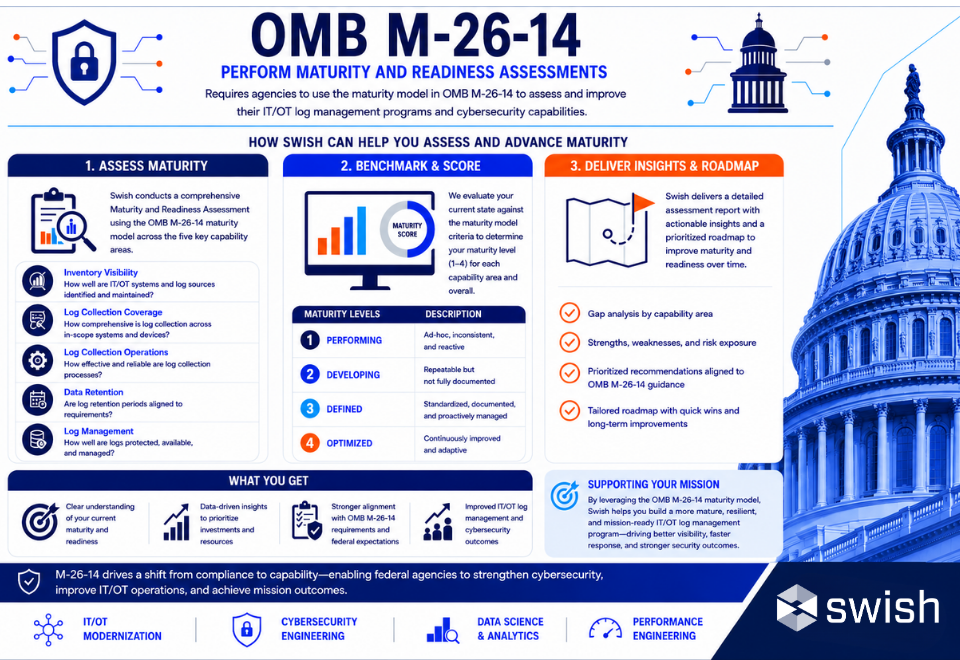
The value of Swish M-26-14 Readiness Assessment extends beyond identifying gaps. Our team delivers maturity scoring, prioritized recommendations, and quick wins that deliver immediate value alongside strategic guidance for long term modernization. The result is a practical, mission focused roadmap measured against clear target outcomes:
The lesson of SolarWinds still holds: you cannot defend what you cannot see. Whether it’s a cloud workload, a network appliance, an IoT camera, or an OT asset supporting a mission function, high quality log data is the building block of effective cybersecurity. As agencies bring generative AI, copilots, and agentic capabilities into their security operations, that data foundation has never mattered more. Agencies that act now will be ready not just for the next mandate, but for the next threat.